
Key Takeaways
- Five solid air conditioning options for homes without ductwork are ductless mini-splits, window units, through-the-wall units, portable air conditioners, and high-velocity HVAC systems.
- Ductless mini splits are the strongest long-term choice for most homes, since they deliver cooling directly to each room and avoid the energy losses that affect traditional ducted systems.
- Window and through-the-wall units suit single rooms well, but they come with trade-offs regarding noise, window access, and the carpentry required for a permanent installation.
- Portable air conditioners give renters and short-term users a flexible option, while high-velocity HVAC systems suit older homes where preserving original walls and woodwork matters most.
- Point Loma Home Pros installs ductless cooling systems across San Diego, with a people-first approach and strong expertise in the older homes where ductwork was never an option.
What is the Best Way to Cool a Home With No Ductwork?
Point Loma Home Pros has cooled San Diego’s older homes for decades, and the most common question we get from owners without ductwork is which AC option actually works best.
For most homes, the answer is a ductless mini-split, which conditions each room directly and avoids the energy losses that plague ducted systems. As a Diamond-Level Mitsubishi Electric dealer, the highest factory designation available, our team installs these systems to a standard most contractors never qualify for, while big-box retailers and general handymen typically default to off-the-shelf window or portable units.
Still, ductless mini-splits are one of five practical options. Window units, through-the-wall units, portable air conditioners, and high-velocity HVAC systems each fit specific situations based on whether you rent or own, how many rooms need cooling, and how permanent the installation needs to be.
This guide breaks down all five and explains where each one fits best.
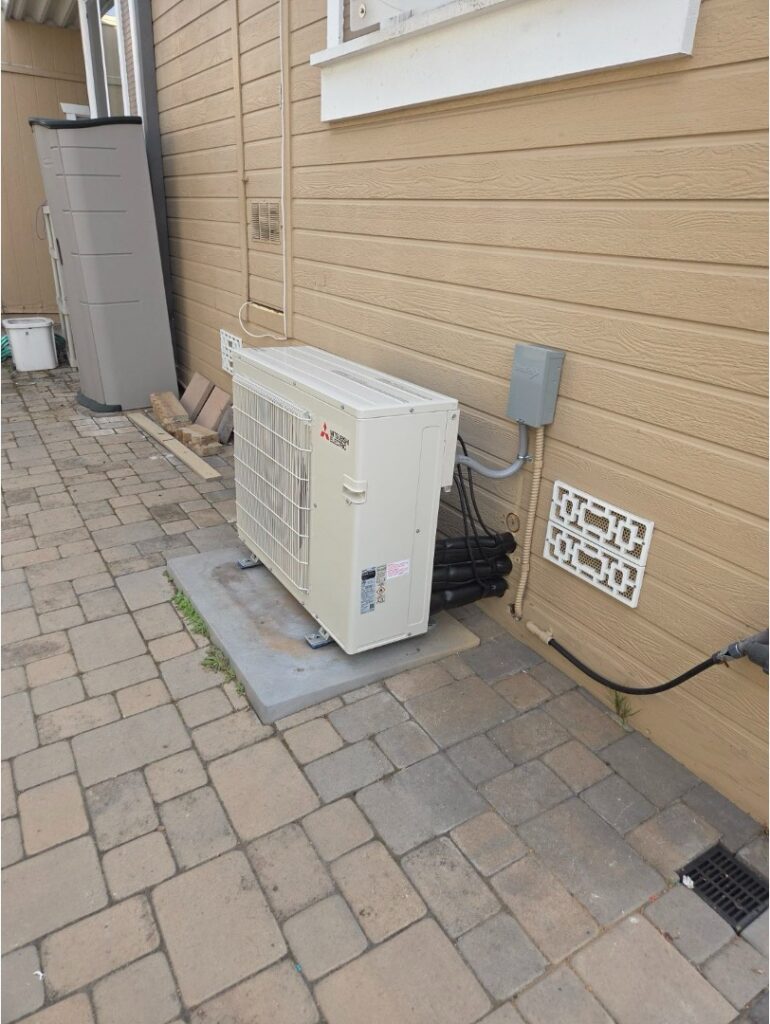
A ductless install pairs an outdoor condenser with one or more indoor heads.

5 Best Air Conditioner Options for a House Without Ductwork
1. Ductless Mini Split Air Conditioners
Ductless mini-splits are the best option for homes without ductwork. They use an outdoor compressor unit connected to one or more indoor air-handling units, linked by a small conduit roughly 3 inches wide that carries refrigerant lines, power, and a condensate drain.
That small wall penetration is all the installation requires, making it far less invasive than building out traditional ductwork. Traditional ducted systems can lose up to 30% of conditioned air through leaks and poor connections, while ductless systems remove that loss entirely.
Ideal Use Cases
Mini-splits are especially well-suited for older homes with plaster walls, homes in climates with hot summers and cold winters (since most mini-splits provide both heating and cooling), and any space where running new ductwork would be cost-prohibitive.
They’re also a smart upgrade for rooms that are perpetually uncomfortable, even with central air, like a home office over a garage or a finished attic.
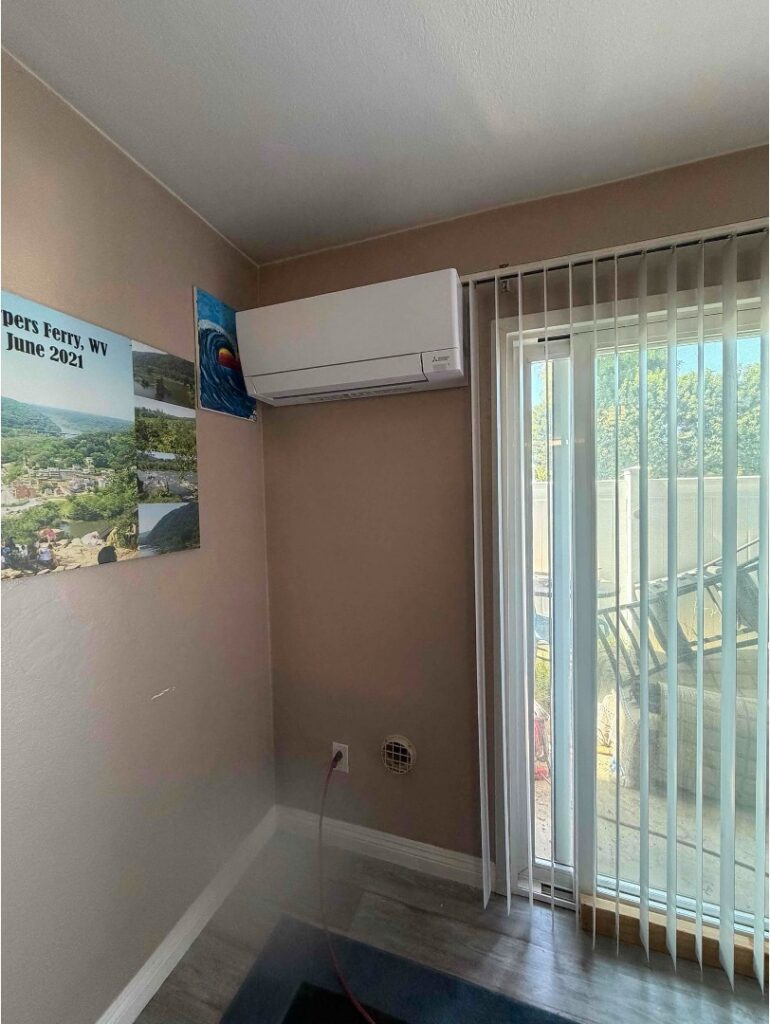
A single ductless mini split head can cool an entire room without any ductwork, with the refrigerant line running through a small wall opening to the outdoor unit.
2. Window Air Conditioners
Window air conditioners are a straightforward ductless cooling solution. They’re self-contained units that sit in a standard window frame, venting hot air outside while blowing cool air into the room.
BTU output is the key spec to focus on. A 150 sq ft room typically needs around 5,000 BTUs, while a 500 sq ft space needs closer to 12,000 BTUs.
Oversizing a window unit is just as problematic as undersizing. A unit that’s too powerful will cool the room too quickly without adequately removing humidity, leaving the space feeling cold and clammy.
Ideal Use Cases
Window units work for renters or as a short-term fix while a permanent solution is being planned. They suit bedrooms, home offices, and small living spaces.
The limitations are noise, reduced natural light from the blocked window, and single-room coverage. For multi-room needs, a single-zone mini split is often the smarter long-term investment.
3. Through-the-Wall Air Conditioners
Through-the-wall units operate similarly to window ACs but are installed permanently in an exterior wall rather than in a window. The installation requires cutting a hole and fitting a sleeve, resulting in a cleaner, built-in look and unobstructed windows. The downside is that the unit becomes a permanent fixture.
Ideal Use Cases
Through-the-wall ACs are best for homeowners who want a permanent single-room solution without investing in a full mini-split setup. They’re a good fit for bedrooms, sunrooms, or home offices where window space is limited or where a cleaner aesthetic matters.
Keep in mind that installation typically requires some carpentry work and possibly a dedicated electrical circuit.
4. Portable Air Conditioners
Portable air conditioners sit on the floor and vent hot air through a hose connected to a window or sliding door. No real installation is required, and the unit can be moved between rooms.
The trade-off is efficiency. Portable ACs draw air from inside the room, cool it, and exhaust the hot air outside, creating negative pressure that draws warm air through gaps around doors and windows. They have to work harder to cool the same space as a window unit or a mini-split with an equivalent BTU rating.
Ideal Use Cases
Portable ACs work for renters who cannot make permanent modifications, as a supplemental option for rooms that only get hot occasionally, or as a backup in the event of a primary system failure.
They are not a strong primary cooling solution for anything larger than a small to medium room.
5. High-Velocity HVAC Systems
High-velocity systems use a network of flexible small-diameter tubes, usually around 2 inches wide, instead of traditional wide ductwork. These tubes can route through walls, floors, and ceilings with minimal disruption.
Ideal Use Cases
These systems are a strong fit for older San Diego homes where preserving original architecture matters. The small outlets blend into walls and ceilings far more discreetly than conventional vents, which protects plaster, ornate moldings, and original woodwork from the damage that wide ductwork would cause.
The main consideration is cost. High-velocity systems are usually more expensive than mini splits and require specialized installation.
Top 5 AC Systems for Homes Without Ducts: Summary Table
| Option | Best For | Key Benefit | Main Limitation |
|---|---|---|---|
| Ductless Mini Split | Long-term whole-home or multi-room cooling | High efficiency with no duct losses | Higher upfront investment than window or portable units |
| Window Air Conditioner | Renters or single-room short-term cooling | Easy setup and removable in winter | Blocks the window, noisier, single-room only |
| Through-the-Wall Air Conditioner | Permanent single-room solution without a mini split | Built-in look, keeps windows usable | Requires carpentry and a dedicated electrical circuit |
| Portable Air Conditioner | Renters, supplemental cooling, or backup use | No installation, moves between rooms | Lower efficiency, single-room only |
| High-Velocity HVAC | Older homes where preserving original architecture matters | Small outlets that protect plaster, moldings, and woodwork | Higher cost and specialized installation |
Why Do San Diego Homeowners Choose Point Loma Home Pros for Ductless Cooling?

The team behind every install: licensed, trained, and focused on the kind of workmanship San Diego homes deserve.
For most homeowners without ductwork, a ductless mini split delivers the best balance of long-term performance and efficiency. It scales from a single room to a whole house and integrates cleanly into older homes where traditional ductwork would be too disruptive. The right setup still depends on your home’s layout, age, and which rooms need to be conditioned.
At Point Loma Home Pros, we take a people-first approach to every install, which means walking you through the options, explaining what each system does in your home, and standing by the quality workmanship we’ve been known for since 1988. As a Diamond-Level Mitsubishi Electric dealer, we hold the highest factory designation available for installation expertise and service quality. We hold an A+ BBB rating and over 2,000 five-star reviews from San Diego homeowners who trust us with their comfort. Schedule your ductless cooling installation with us today.
Schedule your inspection today.
Frequently Asked Questions (FAQs)
What is the most energy-efficient AC option for a home without ductwork?
Ductless mini split systems are the most energy-efficient option for homes without ductwork because they deliver conditioned air directly into the room and avoid duct losses entirely. Most modern units carry SEER ratings of 20 or higher, outperforming window, portable, and most ducted systems.
Can I cool an entire house with a ductless mini split system?
Yes, a multi-zone mini-split system can cool an entire house without ductwork, with one outdoor unit connected to multiple indoor heads in different rooms. Each indoor head operates independently with its own temperature settings.
How much does it cost to install a ductless mini split air conditioner?
A mini split installation typically falls between $8,500 and $20,000, with the exact figure depending on the number of zones, your home’s existing electrical setup, and the refrigerant line paths.
Mini-split installation requires a licensed HVAC technician because refrigerant handling, dedicated circuits, and condensate routing are all part of the work. At Point Loma Home Pros, we handle HVAC and electrical work in-house, keeping everything on one timeline and with one team.
Are portable air conditioners worth it for homes without ductwork?
Portable ACs work well in specific situations for renters or rooms that only need occasional conditioning. They are generally the least efficient ductless cooling option available, and their real-world capacity is often well below the advertised BTU figure. For anything permanent, a mini split or window unit will serve you better.
Do ductless air conditioners also provide heat in winter?
Most ductless mini split systems are heat pumps, which means they provide both cooling in summer and heating in winter using the same equipment. They move heat rather than generate it, drawing warmth from the outdoor air even at low temperatures. In San Diego’s mild winters, almost any modern mini-split heat pump handles heating comfortably year-round.
*Note: All pricing and service information is for general guidance only and reflects typical estimates at the time of writing. Actual costs, scope, and timelines may vary based on the home’s condition, access, materials, project complexity, and local market factors. For more information on our services and current pricing, visit Point Loma Home Pros.